

Triple-frequency ultrasound has reached the UK. LDM® Triple, the German-engineered treatment better known in Seoul as water drop lifting, is now offered by a growing network of 12 clinics across the UK and Ireland. Here is what it does, what the research shows, and what a realistic budget looks like.
LDM® Triple at a glance
| Treatment type | Non-invasive, heat-free ultrasound (Local Dynamic Micro-massage) |
|---|---|
| Made by | Wellcomet, Germany |
| Used for | Skin ageing, acne, rosacea, scarring, hydration, post-procedure recovery |
| Sensation | Warm, massage-like; no pain, needles or numbing |
| Session length | Around 15 to 30 minutes (extended protocols available) |
| Downtime | None |
| Typical course | 6 to 10 sessions, then occasional maintenance |
| Guide price | From about £295 per session; courses £1,500 to £2,250 |
How the technology works
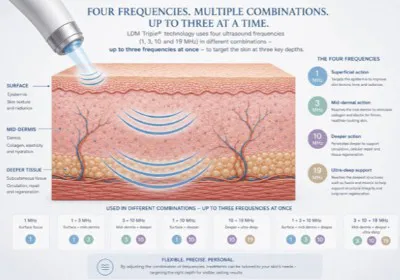
Every ultrasound frequency has a natural working depth: higher frequencies stay near the
surface, lower ones travel deeper. Most devices pick one and stay there.
LDM® Triple’s distinguishing feature is that it transmits three frequencies simultaneously -a little like three radio stations broadcasting at once, each tuned to a different layer of the skin. The surface, mid-dermis and deeper tissue are all reached within the same pass of the applicator.
Just as importantly, the energy is delivered as rapid, low-intensity pulses rather than concentrated heat. The effect is closer to a micro-massage at cellular level than to the thermal treatments many people associate with the word “ultrasound”. That is why practitioners describe it as regenerative: the aim is to calm inflammation, support
hydration and encourage the skin’s own repair processes rather than deliberately injuring tissue to provoke a response.
Learn more about the LDM® Triple technology →
From Seoul to the UK: the water drop lifting story
Readers who follow Korean skincare may recognise this treatment already. In South Korea, the same Wellcomet technology has been a fixture of aesthetic clinics for years under the nickname “water drop lifting”, a reference to the shape of the applicator. It remains one of the most requested non-surgical options among visitors to Seoul clinics, where sessions typically cost the equivalent of roughly £80 to £330.
The Triple is the latest generation of that platform, upgrading from two alternating frequencies to three simultaneous ones. So while the device is new to British clinics, the approach behind it carries years of routine use abroad – a useful reassurance for anyone wary of being an early adopter.
How it differs from HIFU
Because both are “ultrasound facials”, LDM® is often confused with HIFU and Ultherapy.
Mechanically, they are near opposites. HIFU focuses intense energy into precise points to heat and tighten tissue, usually in a single annual session that many patients find uncomfortable. LDM® spreads gentle energy across the tissue with no deliberate heating, is painless, and works cumulatively over a course.
Neither is universally better. HIFU carries the larger evidence base for one-off lifting; LDM® suits sensitive, reactive or inflamed skin and those who prefer gradual improvement without heat. A fair practitioner will tell you which question your skin is actually asking.
What the clinical research shows
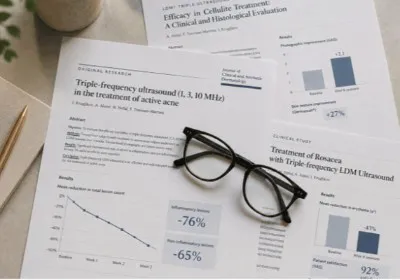
Peer-reviewed studies on the triple-frequency device are recent but consistent in direction:
- A two-centre acne study recorded average improvement of around 74% by the final session, rising to roughly 90% at follow-up, with no serious adverse effects.
- A cellulite case series found improvements were maintained months after the course ended.
- Earlier dual-frequency research showed reduced swelling and bruising after nasal surgery, underpinning its use in post-procedure recovery, and published work supports reduced redness in rosacea-prone skin.
These studies are small and early-stage, as is normal for a newly launched device, and outcomes always vary between individuals. What stands out across all of them is the safety profile: no serious side effects have been reported to date.
What a treatment involves
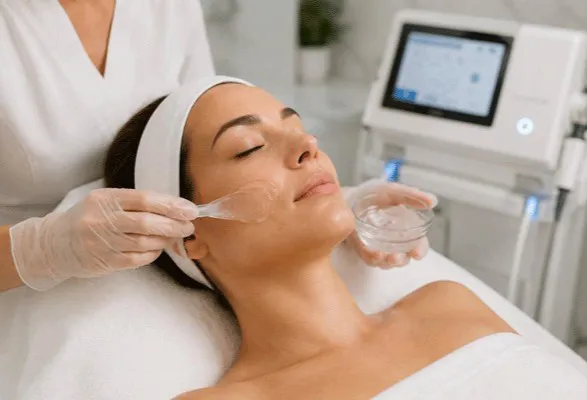
Appointments are simple: conductive gel is applied (the same kind used in pregnancy scans), then the practitioner works the smooth applicator across the area in steady passes for around 15 to 30 minutes. Most people describe the feeling as a warm glide; some doze off.
There is no downtime. Make-up, work and exercise can all resume immediately, with at most a brief, mild flush.
The trade-off for that gentleness is commitment: results build across a course of 6 to 10 sessions rather than arriving in one visit, typically at one to two sessions per week initially, then maintenance every two to three months.
Where to find it in the UK and Ireland
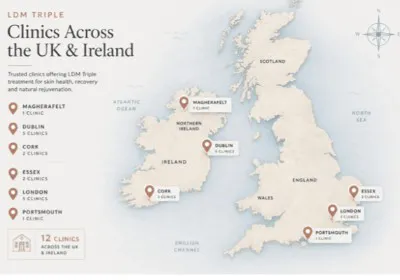
Twelve trained partner clinics currently offer LDM® Triple:
| Region | Clinics |
|---|---|
| London (6) | Dr Marwa Ali at Harrods Wellness Clinic, Dr Preema (Mayfair), Dr Rasha Clinic (Knightsbridge), Future Care Medical (City), Rakus Clinic (Knightsbridge), The PRP Lab (Mayfair) |
| South East (2) | Perfect Skin Solutions (Portsmouth), Maldon Skin Clinic (Essex) |
| Northern Ireland (1) | Escape Beauty Retreat (Magherafelt) |
| Republic of Ireland (3) | FILO Aesthetics (Cork and Dublin), Ora Skin Clinic (Dublin) |
Notably, the UK’s first provider was not a London address but Perfect Skin Solutions in Portsmouth, whose founder Dr Dev Patel serves as the technology’s first UK key opinion leader.
The network is expanding, so check the distributor’s live list for the most current picture in your region.
Budgeting for a course
Published UK pricing currently comes from one provider: £295 for a single session, £1,500 for a course of six, or £2,250 for ten, which brings the per-session rate down to £225. Other clinics quote at consultation, and central London rates may run higher.
The practical advice is to think in course totals rather than session prices, and to ask for the full figure in writing, including any maintenance sessions.
On the plus side, zero downtime means no hidden costs in time off work.
Questions worth asking before you book
Non-surgical treatments remain lightly regulated in England, so a short checklist does useful work:
- Is the device specifically the LDM® Triple, and has the practitioner had hands-on training on it?
- Is the practitioner insured for this treatment, and does the clinic hold membership of a recognised register such as Save Face?
- Will there be a proper skin assessment before any course is priced?
- What exactly does the quoted course include, in writing?
Because the treatment is heat-free, it can be delivered safely by trained skin therapists as well as medical practitioners – one reason it is appearing in high-end skin clinics as well as doctor-led practices.
Wherever you go, a consultation that feels like an assessment rather than a pitch is the strongest signal you have chosen well.