

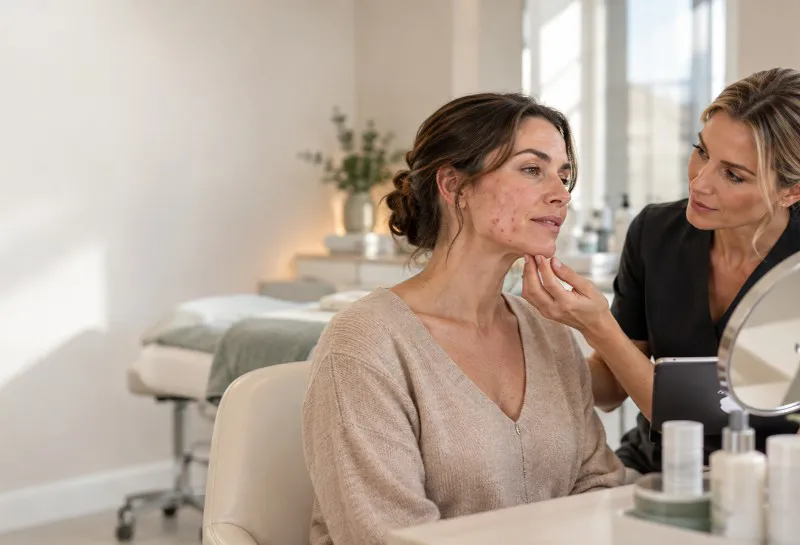


Patients are waiting an average of 43 weeks for a routine NHS dermatology appointment, more than double the NHS Constitution's own target. For a condition that's chronic, visible and often distressing, that's a long time to wait for help.
That gap is exactly where private and aesthetic clinics sit. But acne isn't the market most clinics think it is. It's no longer a teenage-only concern: a growing number of patients seeking treatment are women in their 30s, 40s and 50s, dealing with new or persistent breakouts driven by hormonal change rather than puberty.
Introduction
Acne sits in an odd position in UK aesthetics. It's one of the most common skin conditions in the country, yet it's rarely the first thing a new clinic reaches for when building out its treatment menu. Botox, fillers and skin rejuvenation dominate the conversation. Acne, despite affecting a huge proportion of the population at some point in their lives, is often treated as a GP or pharmacy problem rather than a clinic opportunity.
That's a gap worth examining, because the access picture has changed. Routine NHS dermatology waits now average 43 weeks across the UK, more than double the NHS Constitution's 18-week target, and in some trusts the picture is considerably worse. Patients with ongoing, visible skin concerns aren't inclined to sit on a waiting list for the best part of a year. Many are already looking elsewhere.
At the same time, who actually has acne has shifted. It's still overwhelmingly associated with teenagers, and for good reason: the vast majority of adolescents experience it in some form. But a second, less-discussed population has grown alongside that: adult women, often in their 30s, 40s and 50s, dealing with hormonally driven breakouts that don't respond to the same routines that worked, or didn't, in their teenage years.
For clinics, this creates two distinct, addressable patient groups rather than a single shrinking teenage market. The rest of this piece sets out what that opportunity actually looks like in commercial terms: the demand data, the revenue model, the competitive landscape, and what needs to be in place before a clinic adds acne treatment to its offering.

The NHS Bottleneck Is Building Your Patient List
Routine waits are running well past NHS targets.
The scale of the NHS dermatology backlog is worth sitting with for a moment. Routine dermatology waits average 14 to 18 weeks in England, with the worst-performing trusts reporting delays of 6 to 18 months for non-urgent appointments. Averaged across the UK, patients are waiting 43 weeks for a routine dermatology appointment, more than double the NHS Constitution's target.
Acne is rarely treated as urgent within that system. Unless there's a suspected skin cancer, which follows a separate and much faster two-week pathway, acne patients are placed in the same routine queue as everyone else. For someone dealing with active, visible breakouts, a wait measured in months rather than weeks is a genuine quality-of-life problem, not just an inconvenience.
The regional picture matters more than the national average.
The national figures also understate the problem in some parts of the country. Rural and northern areas experience the longest NHS dermatology waiting times, reflecting significant regional disparities in access. At the same time, urban centres including London generally see shorter waits due to higher numbers of consultants, though demand still creates bottlenecks even there.
For clinics operating outside the major cities, this is a specific, local version of the same opportunity. A clinic in an underserved region isn't just competing on quality or price. It's often the fastest route to treatment full stop.
What this means for who walks through the door
None of this means NHS patients are simply switching to private care wholesale. Cost remains a real barrier, and standard UK private medical insurance typically does not cover acne treatment, since it's usually classified as a chronic rather than an acute condition. But it does mean a meaningful segment of patients, particularly those who can self-fund even a modest course of treatment, are actively looking for an alternative to a months-long wait. Clinics that can offer a faster, structured route to visible improvement are well placed to capture that segment before it goes elsewhere.

Acne Isn't Just a Teenage Condition Anymore
The teenage picture is still enormous.
Start with the numbers most people already assume are true: acne is overwhelmingly common among young people. A British Journal of Dermatology study found that by 2021, 14.6% of UK adolescents and young people were formally diagnosed with acne, a rise of 7.4% since 1990, with UK rates among the highest globally. That's the diagnosed figure. When self-managed cases are included, the true proportion of UK adolescents affected by acne is closer to 95%.
In other words, the gap between “diagnosed” and “actually affected” is vast. Most teenagers with acne never see a clinician about it at all. They manage it themselves, often badly, with whatever's on the pharmacy shelf. That's not a shrinking market. It's a market that's almost entirely self-treated, which is a very different problem from a saturated one.
The patient group clinics tend to miss
The second cohort is where most clinics have a genuine blind spot. Acne in adult women, particularly those in their 30s, 40s and 50s, is not a niche presentation. Dermatologists increasingly report seeing women seeking treatment for persistent or new-onset breakouts well into their 30s, 40s and beyond, often to their own surprise, having assumed acne was something they'd left behind in adolescence.
The mechanism differs from that of teenage acne, and that matters clinically as well as commercially. As women enter perimenopause, which can begin as early as the mid-30s, declining estrogen reduces its balancing effect on androgens, increasing oil production and breakouts, with the hormonal volatility of the 40s and 50s sometimes triggering acne in women who never experienced it before. A skincare routine built around a teenager's skin doesn't address what's happening here.
IMPORTANT: Adult and hormonal acne often respond differently to standard teenage acne protocols, so patient assessment and consultation should account for distinct underlying drivers rather than defaulting to a one-size-fits-all approach.
Why two cohorts beat one
Treating acne as a single, homogenous category undersells the opportunity. A clinic that positions its acne offering purely around teenage skin is speaking to a population that rarely books private treatment and is difficult to reach commercially. A clinic that also builds a proposition around adult, hormonally driven acne is speaking to a self-funding, decision-making adult audience already used to paying for aesthetic treatment; often the same women already booking anti-ageing or skin quality appointments elsewhere in the clinic.
That overlap is worth pausing on. A woman already attending for injectables or skin-quality treatments who is quietly dealing with jawline breakouts she hasn't mentioned is a retention opportunity within an existing patient base, not a new acquisition cost.

The Numbers Behind an Acne Patient
What acne treatment actually costs across the UK
Pricing for acne treatment varies considerably depending on the protocol, the technology used and the severity being treated:
- Single-area laser/light session: £70–£200
- Full-face laser session: £200–£300
- Advanced resurfacing/scarring laser: £400–£950+
- Course of 4 sessions (laser): around £950
- Course of 10 sessions (LED blue/near-infrared): around £650
- Course of 6 sessions (combination protocol): £262–£520
The spread here is the useful part. It means acne treatment isn't locked into a single price point or a single type of clinic. A course-based entry offer sits comfortably alongside premium, longer protocols for more complex or scarred presentations, which gives clinics room to build tiered pricing rather than a single flat offering.
Why the course length matters more than the session price
The more commercially interesting figure isn't the per-session price. It's the duration. Average acne treatment courses last 6 to 9 months, depending on severity and the patient's response.
That's a materially different revenue shape from most single-session aesthetic treatments. A patient booking a course isn't a one-off transaction to be replaced by the next new client. They're on a structured, repeat-visit pathway for the better part of a year, which brings predictable, recurring appointments into the diary rather than a single unpredictable booking.
What that means for the wider patient relationship
A 6- to 9-month course also creates natural touchpoints for clinical review and, where appropriate, for introducing adjacent treatments once active breakouts are under control, such as follow-up work for scarring or pigmentation. None of that needs to be oversold in the first consultation. It's simply a natural consequence of a longer, structured relationship with the patient rather than a single appointment.
IMPORTANT: Course length and pricing should always be set based on individual clinical assessment and severity, not marketed as a fixed guarantee, since acne response time varies significantly between patients.

Where the Competitive Gap Actually Is
London is crowded. Elsewhere, less so
Geography matters more in this category than clinics sometimes assume. Central London, particularly Harley Street, Mayfair and Chelsea, is heavily saturated with established premium clinics. At the same time, the strongest opportunities lie in affluent outer boroughs and regional towns such as Harrogate, Solihull, Jesmond and Nottingham, where competition is lower relative to demand.
That pattern lines up with the NHS access picture covered earlier. Regions with longer NHS dermatology waits and lower clinic density are, by definition, underserved on both fronts. A clinic operating in one of these areas isn't fighting for market share against a dozen established competitors. It may be one of the few structured options a patient has.
Technology is starting to differentiate, not just price
Within the acne category specifically, the market is beginning to reward clinics that move beyond the default laser-or-topical choice. Industry recognition in 2025 went to a laser designed specifically to target acne at the sebaceous gland level, rather than to a generic laser or light therapy offering. That's a signal worth reading carefully: patients and award panels alike are starting to distinguish between “a clinic that offers acne treatment” and “a clinic with a targeted, purpose-built acne protocol.” The two aren't the same thing commercially, even if they sound similar on a treatment menu.
The patient group almost nobody is marketing to
There's one further gap worth naming directly. An independent UK competitor analysis identifies male aesthetics as a broadly underserved segment across the market, with many clinics focusing almost exclusively on female patients. Acne doesn't follow that pattern. It affects men and women differently, but it doesn't skew heavily toward a female-only audience the way much of the wider aesthetics market does. A clinic that markets acne treatment inclusively, rather than defaulting to female-only imagery and messaging, is addressing a segment that most local competitors are simply overlooking.
IMPORTANT: Before expanding into an underserved region, confirm actual local competitor density directly (a 5-mile radius audit is a reasonable starting point) rather than relying on national-level saturation data alone.

What to Get Right Before You Add It
The regulatory direction is clear, even if the detail isn't finalised.
Acne treatment sits inside a regulatory landscape that's actively moving, not static. The DHSC's licensing consultation closed in 2023 with over 11,800 responses, and the government has committed to age restrictions for non-surgical cosmetic procedures on under-18s as part of the wider framework. That matters directly for acne, given that a large proportion of patients are teenagers.
Separately, from 1 June 2025, nurse and midwife prescribers have been required to consult with patients face-to-face before prescribing non-surgical cosmetic medicines, which raises the documentation and consultation bar across the board. None of this is unique to acne, but it does mean clinics building out this part of their offering should treat consent, age verification and record-keeping as foundational, not an afterthought to be tidied up once the licensing scheme is finalised.
IMPORTANT: The UK licensing scheme is not yet fully in force. Clinics should build acne protocols around current requirements now, since retrofitting compliance later is more disruptive than building it in from the start.
Acne is not one condition.
The second thing worth being honest about is that acne is not a single, uniform presentation. Teenage acne, adult hormonal acne, cystic acne and acne linked to underlying conditions can all look superficially similar but respond very differently to the same protocol. A treatment plan built for mild comedonal acne in a 17-year-old is not automatically appropriate for a 42-year-old with jawline-concentrated hormonal breakouts.
This has a practical consequence for how a clinic structures its offering. Proper triage at consultation and a clear referral pathway for patients whose presentation falls outside what the clinic is equipped to treat (particularly severe or cystic cases that may require dermatological or medical management) aren't just good clinical practice. It's what separates a credible, evidence-led acne offering from one that overpromises and underdelivers.
The honest bottom line
Adding acne treatment is not a plug-and-play addition to a treatment menu. It requires real investment: practitioner training, updated consent and documentation processes, and a genuine understanding of when to treat and when to refer on. Clinics that get this right build a defensible, credible offering. Clinics that skip it risk exactly the kind of inconsistent outcomes that make patients, and regulators, sceptical of the category as a whole.
A Practical Next Step
The case for adding acne treatment to a UK clinic's 2026 menu isn't built on a vague sense of “growing demand.” It's built on a specific access gap (NHS waits running well past their own targets), a demographic shift most clinics haven't caught up with yet, and a revenue model that rewards clinics prepared to build a proper, retention-based protocol rather than bolt on a single laser session.
Getting the clinical foundations right, proper triage, referral pathways, and up-to-date consent processes matter as much as the technology chosen to deliver them. For clinics assessing which acne technology fits that brief, the LDM Triple is one option worth reviewing, given its positioning around targeted, non-invasive protocols.
Find out more via the LDM Triple acne campaign page at consultingroom.com/industry/campaign/acne. Alternatively, email us at admin@consultingroom.com with "LDM Triple" in the subject line, and we will send you full details.